When a Tree Stands Between Neighbors, Who Is Responsible?
It is one of the most common questions we hear as a Connecticut tree service: a tree on one property leans, hangs over the line, or drops limbs on the neighbor’s side — and nobody is sure whose problem it is, who can have it cut, or who has to pay. This page explains how Connecticut actually handles it, in plain language.
The short answer: in Connecticut, the tree belongs to whoever’s land the trunk stands on. A neighbor can trim branches back to the property line at his own expense, but he cannot force the owner to remove the tree just by saying it is unsafe — and there is no Connecticut law that automatically makes the owner pay. If a tree falls, liability depends on whether the owner knew the tree was dangerous and did nothing. Because the law is not black and white, the practical answer is usually to deal with a hazardous tree before it becomes a court case, an insurance fight, or a town complaint.
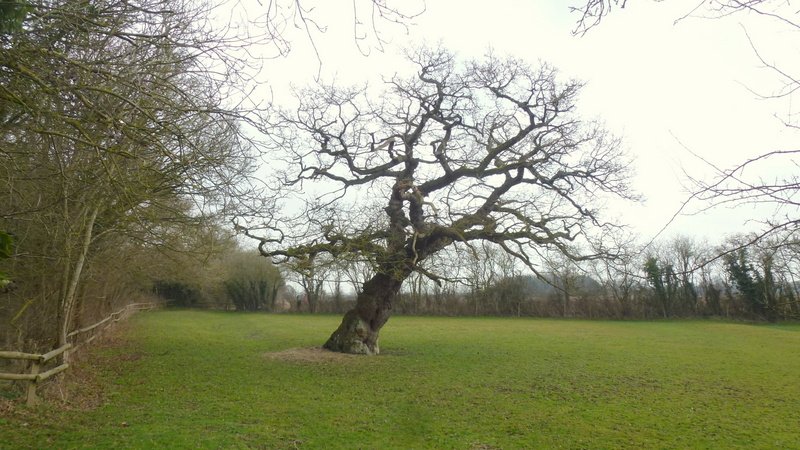
A mature oak leaning hard toward the fence line — exactly the kind of tree that starts neighbor disputes. Photo: Jonathan Billinger / Geograph Britain and Ireland, CC BY-SA 2.0, via Wikimedia Commons.
Whose Tree Is It?
Connecticut follows the trunk rule: if the trunk stands entirely on one property, the tree belongs to that property’s owner — even if the branches and roots cross the line onto the neighbor’s land. Only the tree’s owner can authorize taking the whole tree down.
If the trunk straddles the property line, the tree is shared property. Neither neighbor can remove it or cut it back hard without the other’s agreement.
What Happens If the Tree Falls?
This is where most of the worry lives, and Connecticut’s answer has two parts:
- A healthy tree that comes down in a storm is generally treated as an act of God. Each property owner files with their own insurance for damage on their own side, and the tree owner is usually not liable.
- A tree the owner knew was dead, diseased, or dangerous is different. If the owner knew — or should have known — about the condition and did nothing, the owner can be liable for the damage as negligence.
Connecticut courts have honestly gone both ways on these cases, and no Connecticut appeals court has laid down one final rule. That uncertainty cuts both ways: a neighbor’s written warning is powerful evidence that the owner “knew,” but a warning letter by itself does not automatically shift liability onto the owner the way many people assume. This is general information about how these disputes usually work — it is not legal advice, and a contested situation is a job for a Connecticut attorney.
What Can the Neighbor Do?
- Trim to the line. A neighbor may cut branches and roots back to the property line, at the neighbor’s own expense — without crossing the line, cutting the trunk, or doing the work in a way that kills or seriously harms the tree.
- He cannot cut the tree down. Cutting down or destroying someone else’s tree without permission carries heavy penalties in Connecticut (see below).
- Forcing removal is hard. To compel an owner to remove a tree, the neighbor generally has to go to Superior Court with a nuisance claim and prove — usually with an arborist’s assessment — that the tree is a real danger. Small claims court cannot order a tree removed.
- One more route: the town. Some Connecticut towns, including Coventry, treat dead, diseased, or hazardous trees as blight under their town ordinances. A written complaint to the town can result in the town ordering the owner to correct the problem. Town rules vary, so check your own town’s ordinances.
Who Pays for Removal?
There is no Connecticut statute that splits the cost or forces the tree owner to pay for removal because a neighbor asked. The “hire an arborist, send a certified letter, and the owner pays after 90 days” formula you may see online is not Connecticut law — it comes from bills that were proposed in Hartford several times (most recently in 2025) and never passed.
In real life it works like this:
- The owner pays to remove his own tree.
- The neighbor pays for trimming on his own side, up to the line.
- If a tree falls as an act of God, cleanup where it landed is usually handled by that property owner’s insurance.
- Neighbors often agree to split a removal that benefits both sides — and that agreement should be put in writing before the work starts.
Why We Only Take Removal Orders From the Tree’s Owner
Under Connecticut law (CGS § 52-560), anyone who cuts, destroys, or carries away another person’s tree without permission owes three times the tree’s reasonable value — five times for a Christmas tree — and that penalty reaches anyone who helps do the cutting, including a tree company. An honest mistake still costs the tree’s full value.
That is why Elliott Tree Service will not remove a tree on a neighbor’s say-so. If a tree is coming down, the order has to come from the tree’s owner, and we are glad to put the scope and price in writing for both sides when neighbors are splitting the work.
If You Are in This Situation
For the tree owner
- Get a licensed Connecticut arborist to look at the tree and put the assessment in writing, with dated photos.
- If you receive a written complaint or certified letter, answer in writing and keep copies.
- Let your homeowner’s insurance company know about a hazardous tree before anything falls, not after.
- If the trunk is anywhere near the line, a survey settles whose tree it is.
- If you and your neighbor agree to split a removal, get the split in writing.
For the neighbor
- You can trim back to your property line now, at your own expense — stay on your side and do not harm the tree.
- Have an arborist document the condition, and send your concern to the owner in writing (certified mail, keep the receipt).
- Check whether your town’s blight ordinance covers hazardous trees.
- Notify your own insurer about a tree you believe is a threat to your home.
How Elliott Tree Service Can Help
As a licensed Connecticut arborist (CT Arborist License #PMCS.0066329), we assess questionable trees, document their condition in writing, and give you a firm price for the options — removal, or in the right case, support cabling and deadwood removal to keep a tree standing safely. A written arborist assessment is exactly the document that matters most in these disputes, whichever side of the fence you are on.
Have a tree you are worried about — yours or your neighbor’s? Call or text 860-230-8260 for a free estimate. We reply the same day.
This page is general information about Connecticut practice, based on state statutes, published court decisions, and guidance from the Connecticut Insurance Department and the legislature’s research office. It is not legal advice. For a live dispute, consult a Connecticut attorney.